The Science Behind Grip Strength
A landmark study published in the Journal of Orthopaedic & Sports Physical Therapy examined grip strength across the lifespan in Americans aged 18 to 85 years. Researchers analyzed data from 1,232 participants in the National Institutes of Health (NIH) Toolbox project to establish reliable reference values for grip strength in the United States.
The purpose of the research was to create normative benchmarks that allow clinicians to compare an individual’s grip strength to expected values for their age, sex, height, and weight.
The findings confirmed that grip strength varies across the lifespan, peaking in early adulthood and gradually declining with age. For example, average grip strength reaches approximately 49.7 kilograms in men aged 25–29, while later in life it may decline to around 18.7 kilograms in women aged 75–79.
By establishing these reference values, clinicians now have a practical way to determine whether a patient’s muscle strength is appropriate for their age—or whether it may signal underlying health concerns.
Grip Strength: A Window Into Whole-Body Health
While it may seem like a simple measure of hand strength, grip strength is actually a reliable indicator of overall muscular health. Research consistently shows that grip strength correlates with total body strength, functional capacity, and mobility.
Reduced grip strength has been associated with:
Because of these associations, grip strength is increasingly viewed as a functional biomarker of aging—a quick way to assess how well the body is maintaining strength and resilience over time.
A Marker Strongly Linked to Longevity
Grip strength is not just a measure of physical capability—it is a powerful predictor of long-term health outcomes.
The landmark Prospective Urban Rural Epidemiology (PURE) study, published in The Lancet, demonstrated that lower grip strength is strongly associated with increased risk of all-cause mortality, cardiovascular mortality, and cardiovascular disease. Notably, grip strength was found to be a stronger predictor of mortality than even systolic blood pressure in some populations.
These findings reinforce that grip strength reflects the health of multiple systems simultaneously, including:
As these systems decline, grip strength declines—making it a highly sensitive and clinically useful early warning signal.
New Insights: Strength as a Predictor of Survival
More recent clinical insights further reinforce the importance of muscle strength. In The Strong Survive: Muscular Strength and Mortality (2026), Dr. F. Perry Wilson highlights a critical concept:
The article emphasizes that individuals with greater strength consistently demonstrate:
Importantly, strength predicts outcomes independently of traditional risk factors, adding meaningful clinical insight beyond standard measurements such as cholesterol or blood pressure.
Strength, therefore, serves as an integrated marker of biological robustness—capturing how well the body can perform, adapt, and recover.
Why Grip Strength Is the Ideal Clinical Tool
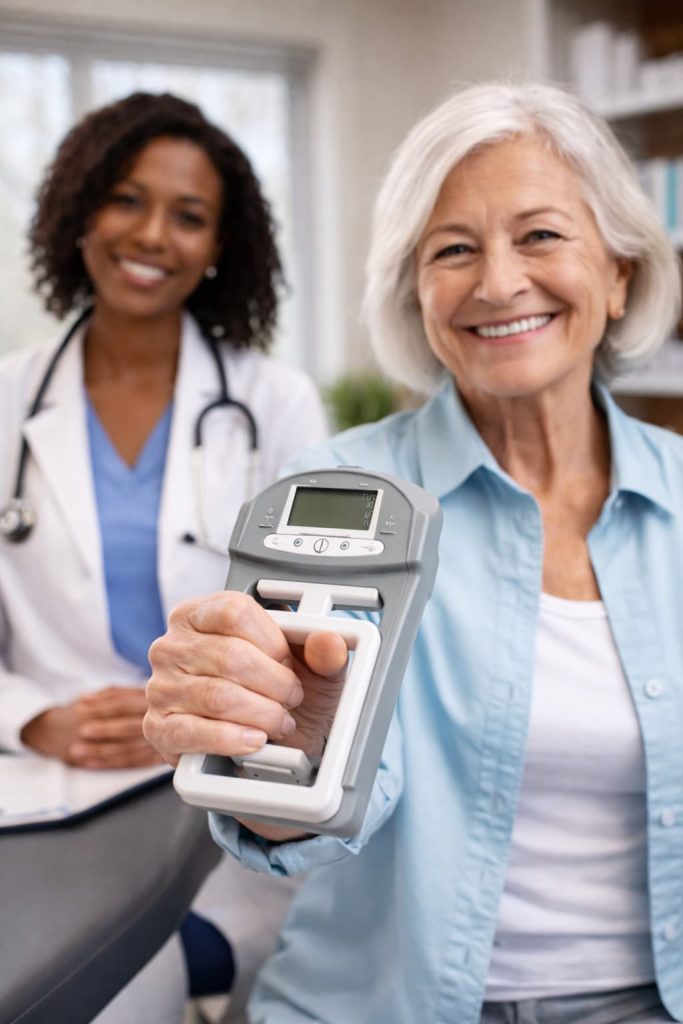
Grip strength has emerged as one of the most practical ways to measure muscular strength in a clinical setting.
This makes it an ideal tool for routine use in primary care—especially in a preventive and longevity-focused practice.
Why Dr. Ilyadis Measures Grip Strength
At Island Health, Dr. Ilyadis takes a proactive approach to patient care, focusing on early detection and long-term health optimization. Grip strength testing is a key part of this philosophy.
By incorporating this measurement into routine physical exams, she is able to:
A Simple Test with Powerful Preventive Value
In less than a minute, this test provides meaningful insight into:
The Future of Preventive and Longevity Medicine
As healthcare continues to shift toward prevention and longevity, tools like grip strength testing are becoming essential.
The message from decades of research and modern clinical insight is clear:
At Island Health, Dr. Ilyadis integrates evidence-based assessments like grip strength testing into routine care to help patients maintain strength, independence, and long-term health.